Decoding Multiplier Behavior Across Slot Volatility Ranges
Written by Greta Wolf · Jul 23, 2026

Decoding Multiplier Behavior Across Slot Volatility Ranges
Slot mechanics rely on volatility to shape how often wins occur and how large those wins become, while multipliers add another layer by scaling those outcomes upward. Low-volatility titles deliver frequent smaller returns that multipliers can boost without creating extreme swings, whereas high-volatility games produce infrequent but larger base wins that the same multipliers amplify into substantial results. Data from multiple gaming jurisdictions shows these interactions follow predictable mathematical patterns once volatility categories are defined by standard deviation measures.
Core Definitions and Measurement Standards
Volatility categories emerge from calculations that track the spread between average returns and actual outcomes over thousands of spins, with low-volatility slots maintaining tight distributions and high-volatility ones showing wide variance. Multipliers appear as fixed values such as 2x or 5x during base play or as random triggers in bonus rounds, and their placement within the paytable determines whether they compound with other features like wild substitutions. Researchers at institutions including the University of Nevada, Las Vegas have documented how these elements combine to alter the overall return-to-player percentage in controlled simulations.
Medium-volatility games sit between the two extremes and often incorporate multipliers that activate more regularly than in high-volatility titles yet produce less dramatic scaling than repeated high-volatility triggers. Observers note that game developers adjust multiplier frequency and size to keep the mathematical model balanced across volatility tiers, ensuring the long-term expected value remains consistent even as short-term experiences differ sharply.
Low-Volatility Interactions
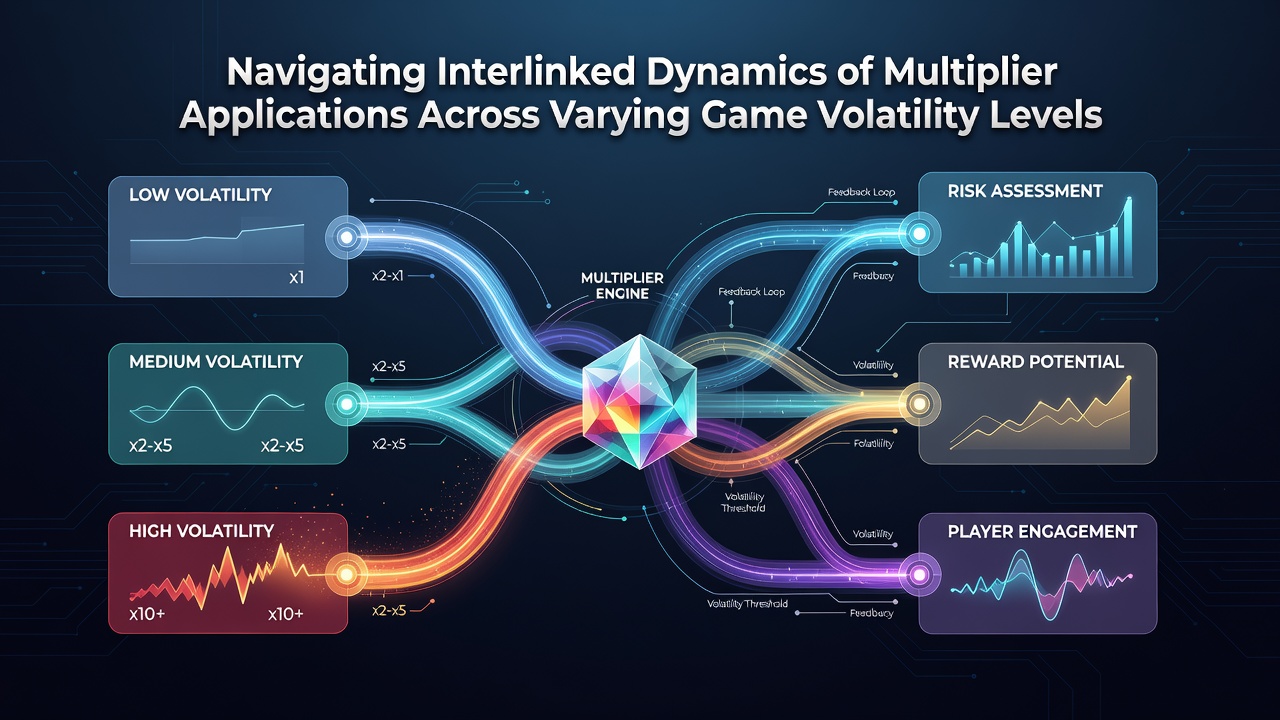
In low-volatility environments multipliers typically appear on almost every other spin or through simple reel modifiers, raising modest base wins by modest amounts that accumulate steadily over time. Players encounter sequences where a 3x multiplier lands on a two-symbol payout, turning it into a six-symbol equivalent without shifting the overall session trajectory dramatically. Figures from the Nevada Gaming Control Board indicate that these titles maintain hit frequencies above 30 percent, allowing multipliers to function as incremental enhancers rather than game-changing events.
Medium-Volatility Patterns
Medium-volatility slots introduce multipliers that trigger less often but deliver larger scaling factors, creating noticeable peaks within an otherwise even distribution of results. A 10x multiplier might appear during a free-spin sequence that occurs every 80 to 120 spins on average, lifting an already respectable base win into territory that stands out from surrounding outcomes. Studies conducted by the Australian Institute of Criminology have examined how these mid-tier designs balance multiplier rarity with payout size to sustain player engagement across longer sessions without the extreme dry spells seen in higher-volatility counterparts.
High-Volatility Dynamics
High-volatility titles reserve multipliers for rarer events, often embedding them inside complex bonus rounds that require specific symbol combinations or progressive triggers. When a 25x or 100x multiplier activates on a large base win, the resulting payout can exceed several hundred times the initial stake, yet such events remain statistically infrequent. The interlinked nature becomes clear when examining how volatility settings dictate the probability weightings assigned to multiplier symbols during random number generation, a process that keeps overall return percentages within regulatory tolerances across different game designs.
Developers sometimes layer additional multipliers onto existing ones during special modes, producing multiplicative rather than additive effects that further widen the outcome distribution in high-volatility games. This stacking mechanic remains tightly controlled by the underlying random number generator to prevent any single session from deviating too far from the programmed mathematical model.
Cross-Tier Comparisons and Recent Industry Data
Comparative analyses reveal that the same nominal multiplier value produces markedly different session experiences depending on the host game's volatility setting, with low-volatility applications smoothing bankroll curves and high-volatility applications creating pronounced spikes separated by extended flat periods. July 2026 updates to simulation software used by testing laboratories have allowed more granular tracking of these interactions, confirming that multiplier placement within paytables exerts measurable influence on short-term variance metrics.
Industry reports from the American Gaming Association highlight continued refinement of multiplier algorithms as developers seek to differentiate titles within competitive markets while preserving compliance with jurisdictional standards. Those refinements often involve adjusting trigger rates rather than changing the multiplier values themselves, a method that preserves the core mathematical relationship between volatility and payout scaling.
Conclusion
Multiplier applications remain inseparable from the volatility framework that governs each slot title, producing distinct behavioral patterns that players can anticipate once they understand the underlying categories. Regulatory data and academic simulations continue to map these relationships with increasing precision, providing clear frameworks for evaluating how scaling mechanics interact with different volatility profiles across current game libraries.