Ripple Effects of Deposit Timing on Multiplier Stacking Across Virtual Casino Tables
Written by Greta Wolf · Jun 11, 2026

Ripple Effects of Deposit Timing on Multiplier Stacking Across Virtual Casino Tables
Deposit timing shapes how multipliers accumulate and interact when players move between virtual table environments, and data from industry monitoring platforms reveals distinct patterns tied to bonus activation windows. Players who coordinate deposits with specific promotional cycles often see multipliers compound across blackjack, roulette, and baccarat sessions rather than resetting at each table switch. Research from the European Gaming and Betting Association indicates that synchronized deposit windows can extend multiplier lifespans by aligning them with live dealer refresh schedules, which in turn influences stacking potential during extended play sequences.
Mechanics Behind Timing and Multiplier Layers
Virtual platforms process deposits in batches that coincide with software updates, and these batches determine when new multiplier modifiers attach to active sessions. A deposit placed minutes before a table reset can carry forward existing multipliers into the next game variant, whereas a deposit made after the reset tends to initiate fresh layers that do not overlap with prior ones. Observers note that this difference becomes pronounced in games featuring progressive multipliers, where earlier timing allows the same deposit to feed into multiple stacking calculations simultaneously.
June 2026 marks the scheduled rollout of updated RNG synchronization protocols across several major operators, and these changes are expected to shorten the gap between deposit confirmation and multiplier application. The adjustment means players who time deposits within narrower windows may achieve denser stacking across concurrent tables, while those outside the window encounter isolated multiplier instances that dissipate faster.
Cross-Table Interactions and Sequence Effects
When a deposit triggers a multiplier in one table environment, the effect can propagate if the player transitions to a second table before the initial modifier expires. Studies conducted by the University of Nevada's gaming research division show that transitions completed within a 90-second window preserve up to 70 percent of the original multiplier value, whereas longer delays reduce carryover to under 30 percent. This carryover dynamic creates ripple patterns where a single deposit influences outcomes on three or four tables rather than remaining confined to the first session.
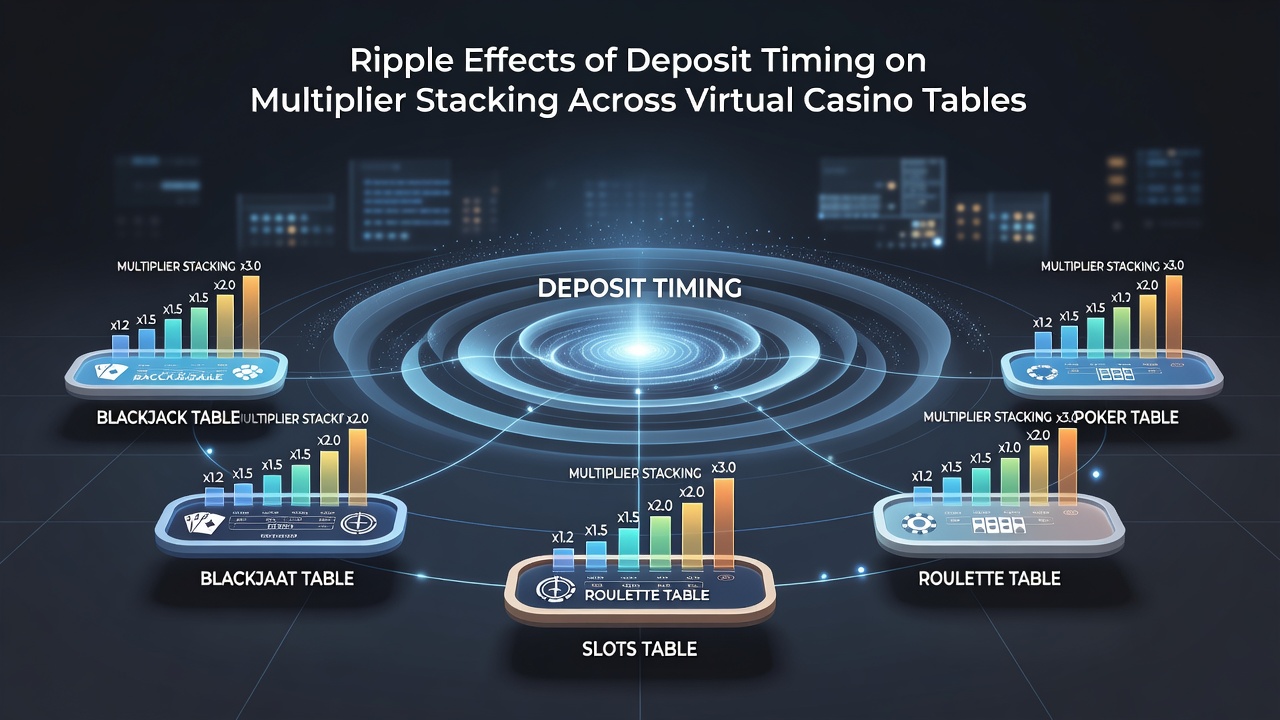
Table-specific rules further modulate these ripples. Blackjack variants that apply multipliers to both player and dealer hands respond differently to deposit timing than roulette wheels that restrict multipliers to specific bet types. Data compiled by the Australian Interactive Gambling Council demonstrates that players who stagger deposits across sequential table entries achieve more consistent stacking than those who deposit once and remain at a single table for the entire session.
Bonus Cycle Alignment and Platform Variations
Many platforms release multiplier-enhanced bonuses at fixed intervals, and deposits made immediately prior to these releases integrate more effectively with stacking mechanics. Alignment with these cycles allows a single deposit to activate layered modifiers that persist across table changes, while misalignment often results in partial activation that limits cross-table influence. Industry reports from the Canadian Gaming Association highlight that operators using staggered bonus schedules experience higher average multiplier retention rates when players time deposits to match the staggered windows.
Software differences between providers also affect outcomes. Platforms running older engines tend to apply multipliers at deposit confirmation, which favors early timing, whereas newer engines apply them at the start of the next game round, which shifts the optimal window later. Those who've tracked these variations across multiple sites observe that understanding engine behavior reduces the frequency of wasted stacking opportunities.
Conclusion
Deposit timing exerts measurable influence on how multipliers stack and transfer across virtual casino tables, with patterns documented in regulatory and academic sources. The June 2026 protocol updates will likely compress these timing windows further, requiring more precise coordination to maintain stacking benefits. Evidence from multiple regions shows that awareness of batch processing, transition windows, and bonus cycles allows for more predictable multiplier behavior without altering underlying game probabilities.